MINETWIN CASE STUDY #6
THE OBJECTIVE
To validate technical design decisions and assess mine performance at years 1, 7, 15, and 25 of operation.
Tasks included:
- Accounting for equipment downtime caused by weather conditions
- Evaluating the efficiency of a conveyor-truck hybrid haulage system
- Determining the optimal equipment fleet (including tailings transport from the processing plant)
THE CLIENT
A greenfield open-pit iron ore deposit located in a sub-arctic region.
THE SOLUTION
Simulation scenarios were developed for key stages of life of mine.
The model accounted for:
- Seasonality of equipment units’ downtimes
- Transportation of tailings from the processing plant
Performed scenario analysis (CAPEX, OPEX).
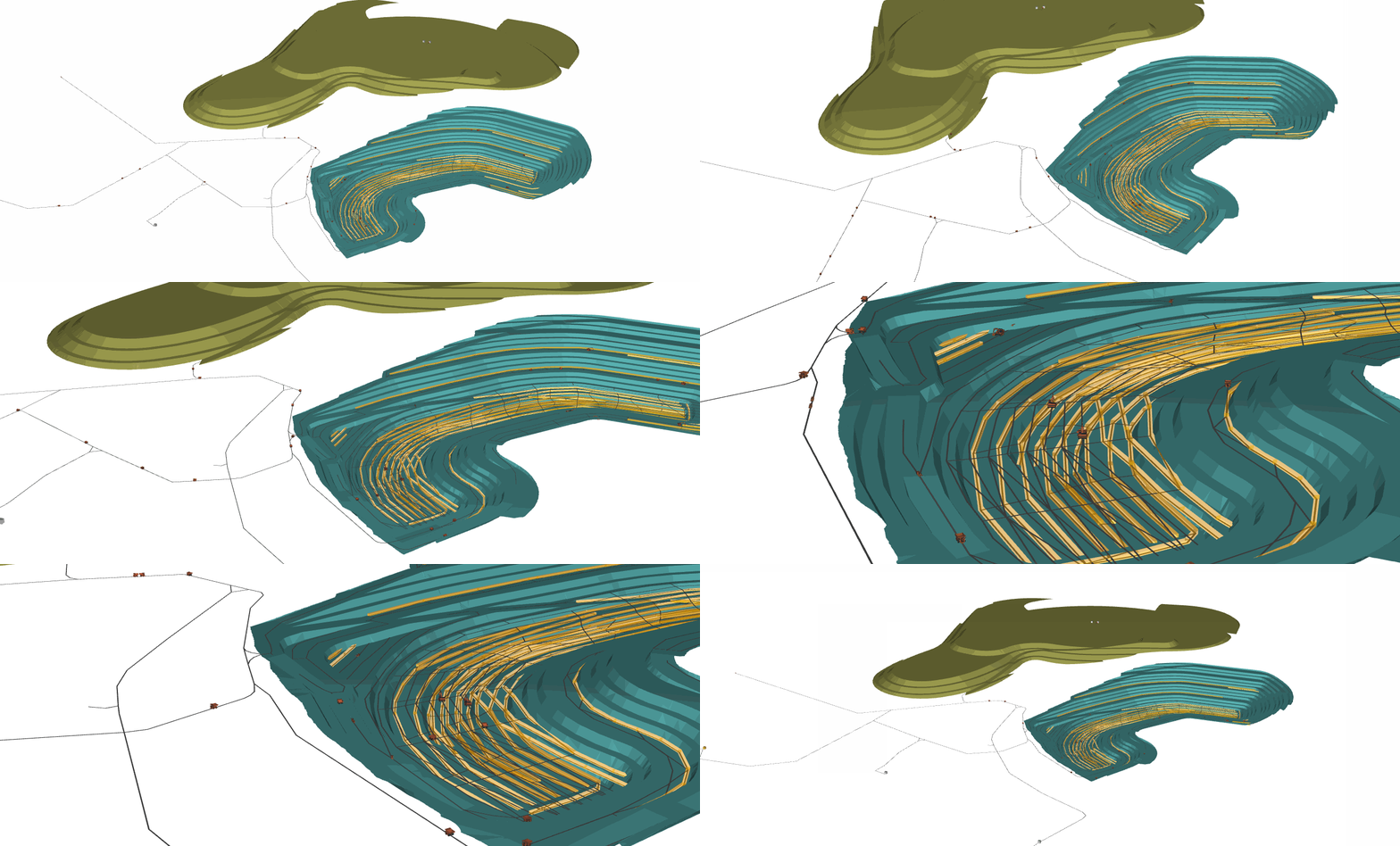
Integration with the mine’s geological information system enabled automated scenario setup.
THE RESULTS
- The project layout was updated — the processing plant was relocated closer to the pit.
- Haulage technologies for ore and waste were compared.
- Optimal fleet sizes were determined, and production bottlenecks were identified.
Quantitative Effects:
- Adding one 20 m³ shovel increased production by +1.48 Mt of ore and +2.3 Mt of waste.
- Optimized bulldozer fleet: 8 instead of 9 (saving ≈ USD 300–400K).
- A conveyor system for tailings transportation proved to be over 2 times more efficient than 130-t trucks.
PROJECT CONTEXT
The project simulated the mine’s operation and processing plant for multiple stages (years 1, 7, 15, 25).
Each stage included:
- Comparison of overburden haulage options: trucks, conveyor-based haulage, or a combined system
- Consideration of seasonal effects (low temperatures) causing downtime and reduced productivity
- Validation of engineering design and fleet sizing based on performance and availability criteria
- Scenario-based analysis using discrete-event simulation and interpretation of results
Additionally:
Integration with the geological information system automated block creation for ore and waste, accelerating scenario preparation.
KEY QUESTIONS
Modeling with MineTwin was used to answer:
- Are the design assumptions for the plant and fleet valid?
- What fleet configuration is optimal for achieving ore and waste targets?
- How many bulldozers are required for dumps, cleaning, and ore stockpiles?
- When does the conveyor-based haulage system become economically justified?
- What is more efficient — conveyor or truck transport of tailings?
- How does weather affect mining productivity?
FLEET CALCULATIONS
Bulldozer fleet optimization:
Optimal: 8 instead of 9 units → saving USD 300-400K
Confirmed requirement: 10 units at 260–300 t/h productivity
Excavator fleet (year 7):
Adding one additional excavator (20 m³ shovel) increases production by:
- +1.48 Mt ore,
- +2.3 Mt overburden
PLANT-RELATED FINDINGS
- The conveyor system for tailings transport was more than twice as efficient as 130-t trucks.
- Simulation confirmed the need to relocate the processing plant closer to the pit to reduce haul distance and improve profitability.
WHY MINETWIN
Designed specifically for mining:
- Unlike general-purpose tools, MineTwin accurately reproduces both open-pit and underground operations
- It models detailed equipment interactions, including cyclic-continuous haulage systems, capturing nonlinear constraints and dependencies invisible in Excel or linear programming.
Bridging strategic planning and operations:
- MineTwin validates plan feasibility while considering equipment availability, geological conditions, and operational constraints
Scalable and adaptable:
- It enables creation of an internal competence center capable of building models for multiple mines on a single platform
- MineTwin is flexible enough to adapt to different mine layouts and process configurations
- After implementation, internal teams can independently perform scenario analyses, fleet optimization, and operational assessments — supporting continuous improvement and data-driven investment decisions.
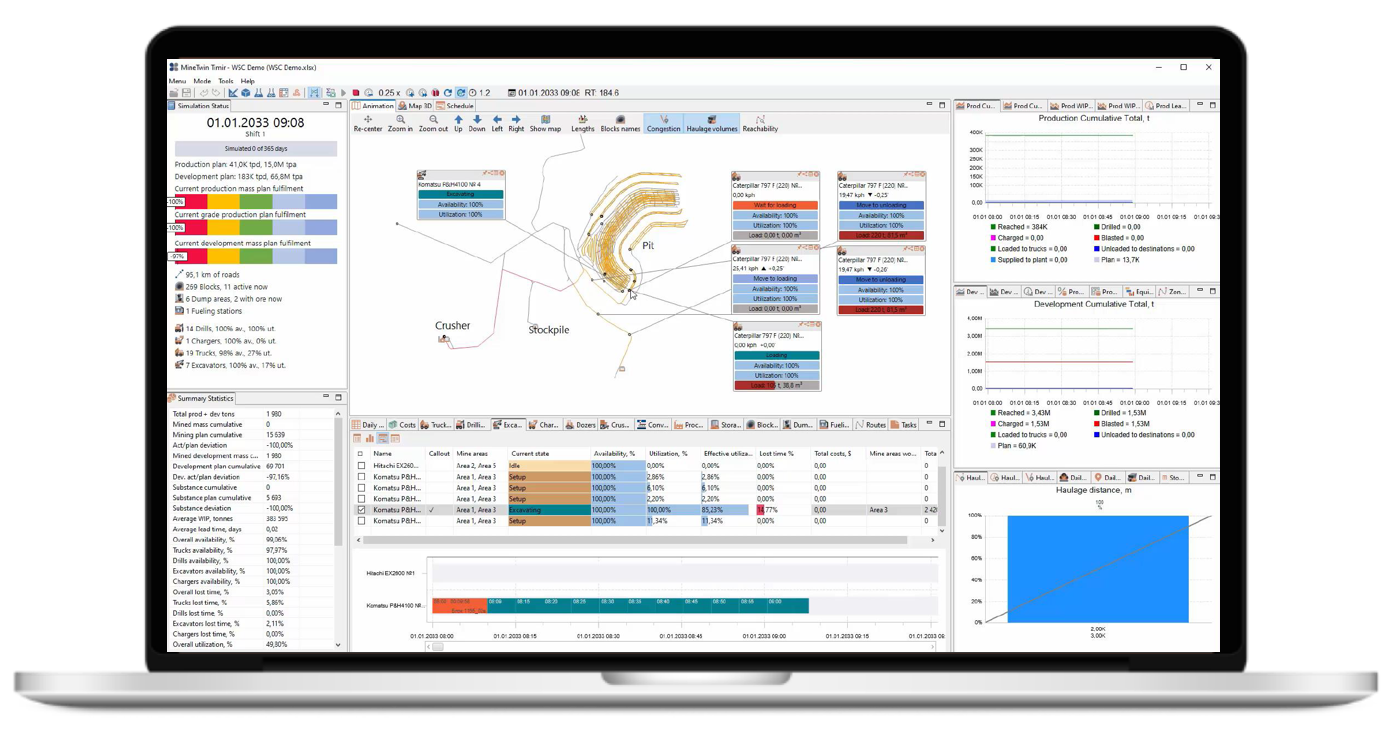
Using simulation has become an industry standard in mining
Todays modern simulation tools, such as MineTwin, allow to speed-up creation of simulation models.